

Forage Harvester Price in India: Mini, 2-Row and Silage Machine Buying Guide
For dairy farmers, fodder producers and agricultural contractors, the purchase of a forage harvester is a major decision. The right machine can aid in organising harvesting, reduce manual handling and prepare chopped forage for feeding or silage. However, selecting machines only by the advertised price may result in an inappropriate purchase.
The cost of a forage harvester in India depends on the model, the type of harvesting system, the crops it can handle, the power it requires, and the equipment it comes with. A compact tractor-operated machine, a two-row harvester, and a self-propelled model represent the different levels of investment.
This guide shows you how to compare silage chopper prices, understand dealer quotes and choose equipment that fits your farm’s workload.
Also Read: ट्रैक्टर वाली कुट्टी मशीन क्या है? जानें इसके फायदे, कीमत और सही मशीन चुनने का तरीका
What is a forage harvester?
A forage harvester is an agricultural machine used to cut or gather suitable crops, chop the material, and then unload it into a collection system.
Depending on the type of machine and attachment, it could be used for crops such as maize, sorghum, pearl millet, oats, and Napier grass. The crop suitability has to be checked for the specific model. For example, SHAKTIMAN has these applications for its two-row forage harvester. shaktimanagro.com
The harvester cuts the crop and gets it ready for silage. Proper management of transport, compaction, sealing, and fermentation are also separate stages.
Before you ask for a silage machine price, make sure you know what equipment you want:
- A field harvester for cutting and chopping standing crops.
- A stationary chopper for previously harvested fodder.
- A baler or compactor for packing chopped material.
- A wrapper for sealing suitable bales.
The machines are for different jobs and should not be thought of as equivalent products.
Forage Harvester Cost In India
Not everyone pays the same price for a forage harvester. The published prices are good starting points, but you will need a quote for the model in question to determine the purchase price.
The following examples show prices for identifiable models.
| Machine or model | Published price | Buying consideration |
| Nandi Single Row Forage Harvester | ₹4.50 lakh | Confirm the exact specification, included equipment and delivery charges. |
| Vidhata JF C-90 single-row forage harvester | ₹7.50 lakh | Check tractor compatibility and quotation inclusions. |
| Vidhata JF AT1000 forage harvester | ₹11.36 lakh | Compare harvesting arrangements and crop suitability. |
| Nandi Row Independent Forage Harvester | ₹14 lakh | Confirm working width, power requirements and supported crops. |
| Self-propelled forage harvester | Request a model-specific quotation | Specify the engine, header, processing equipment and support package. |
These are published seller or supplier prices reviewed in Oct 2026, not a complete market price range. Prices are ex-Agra, and transport, installation and other conditions are subject to confirmation,” says the Vidhata catalogue. Double-check all prices, taxes, and inclusions before ordering. These are not G-Class prices. Character.
Mini Silage Machine Price in India
A reliable comparison of mini silage machine prices in India starts with what the machine does.
“Mini” is not a standard capacity or specification. A field harvester might be advertised as having a compact stationary chopper, yet the field harvester also cuts the standing crop.
Request the supplier to supply:
- The model name and equipment category.
- Supported crops and harvesting method.
- Recommended tractor or other power source.
- Working width or row arrangement.
- Included attachments.
- A complete delivered-price quotation.
A low advertised price only is of help if the machine can do the work your farm needs.
Factors Influencing Price – Machine Setup
A tractor-operated implement is pulled behind another tractor. A self-propelled harvester is an implement with its own engine and drivetrain.
When comparing prices, find out if the price is for the implement alone or for the complete operating installation. That additional investment impacts the purchase decision if they need a different tractor.
2. Header and Harvesting Layout
The design of single-row, two-row, and row-independent harvesters is different.
The header has to fit the crop and the planting configuration. A less expensive machine may not be suitable if it does not work well with your row spacing or field conditions.
3. Equipment for Chopping and Processing of Crops
Models offer different chop-length settings, blade configurations, sharpening systems, and crop-processing components.
Find out what features are standard and what is extra. Forget about a feature list to judge performance. Ask for a demo and try the chopped material.
4. Power Needs
The engine horsepower alone is not sufficient to determine compatibility with tractor-operated equipment.
Check manufacturer requirements for PTO power, PTO speed, hitch arrangement, lifting capacity, and hydraulics where applicable.
5. Delivery and Installation Services
Transportation, unloading, assembly, and commissioning can influence the final silage machine price in India.
Ask for a quote that lists these charges separately so you can compare quotes from different suppliers on a level playing field.
6. Service and wearing parts
During the working life of the machine, blades, bearings, belts and other components may need to be maintained or replaced.
Ask for parts prices, stock availability and local service arrangements. The purchase price must be seen in the context of the cost of keeping the machine operational.
Mini, 2-Row and Self-Propelled Forage Harvesters
These descriptions are for different aspects: ‘mini’ refers to the size, ‘two-row’ to the harvesting arrangement, and ‘self-propelled’ to the power and drive system. They are not always mutually exclusive.
| Description | What it tells you | What to check |
| Mini forage harvester | Usually indicates compact equipment. | Actual function, capacity, crop suitability and power requirements |
| Tractor-operated forage harvester | Uses power from a compatible tractor | PTO requirements, mounting, tractor availability and stability |
| Forage harvester 2-row | Designed to harvest two crop rows per pass | Supported row spacing, header design and practical output |
| Self-propelled forage harvester | Has its own engine and drive system | Complete configuration, annual workload, transport support and service |
Selecting a Mini Forage Harvester in India
Where practical machine size is restricted by field access, available power or workload, compact equipment may be worth considering.
But a small farm does not have to have the smallest machine. The crop still needs to be harvested in that window, and ownership versus rental or shared use should be compared.
Selecting a 2-Row Forage Harvester
A two-row machine cuts two rows at a time, but the daily amount cut is not determined by the number of rows. Speed of operation, availability of trailers, field layout, and crop yield are also important.
Ask the dealer to demonstrate the machine on a crop and planting configuration like yours.
How to Select a Self-Propelled Harvester
A self-propelled machine should be judged in terms of a complete harvesting operation.
In addition to the machine quotation, consider operators, trailers, fuel, maintenance facilities, and the amount of work available each season. A high harvesting capacity must be matched by a transport and storage system.
Price of Corn Silage Harvester Machine in India
The price of a maize silage harvester machine in India depends on more than just the number of rows it can harvest.
Two maize harvesters can differ in:
- Row-dependent or row-independent feeding.
- Working width.
- Tractor power requirements.
- Chop-length adjustment.
- Kernel-processing equipment, where offered.
- Discharge controls.
- Included shafts, fittings and accessories.
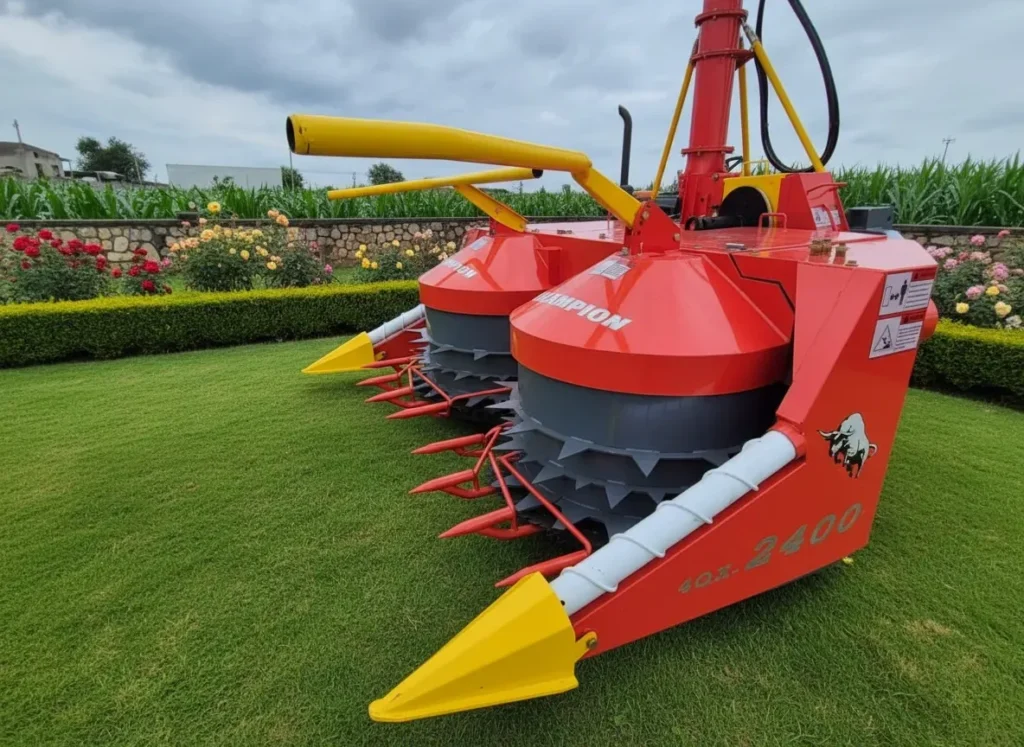
Published models include a single-row Nandi model at ₹4.50 lakh and a row-independent Nandi model at ₹14 lakh. These are different listed products, not a universal price range for maize silage harvesters. sfmagro.com
If you want to compare apples to apples, send each supplier the same requirements: crop, row spacing, acreage, tractor model, expected workload, and delivery location.
Forage Harvester Manufacturers & Exporters in India
When searching for “top forage harvester manufacturers in India”, farmers need to look for verified products and local support, instead of assuming a brand list is an independent ranking.
Examples of businesses that provide forage harvesting equipment include:
| Business | Verified offering | Information to request |
| G Claas | Forage harvesting and silage equipment | Available models, compatibility, demonstration and quotation |
| SHAKTIMAN | Two-row forage harvester | Current specifications, dealer availability and price |
| Basant Products India / Vidhata JF | Listed JF forage harvesting models | Product origin, supply terms, installation and service |
| SFM Agro / Nandi | Listed single-row and row-independent forage harvesters | Exact model, manufacturer details and support arrangements |
These businesses are different in terms of roles and product ranges. Check whether the supplier of the machine you have selected is the manufacturer, importer, distributor, or dealer.
GClaas Buy a Forage Harvester Direct from the Equipment Business
Contact the manufacturer or supplier through their official channels. Tell us what you grow, your tractor details, annual acreage and location, and we’ll make a relevant recommendation.
From Authorised Dealers Forage Harvester
Ask the brand to confirm that the dealer is currently authorised. Before paying, get the machine details, invoice terms, warranty conditions and delivery commitments in writing.
Also learn who will be responsible for commissioning, operator training and repairs.
By Agricultural Equipment Marketplaces
You can look online for models and suppliers. But please check the seller, the machine configuration, and the final quotation directly before placing an order.
A listing with a photograph and a starting price doesn’t say what will be delivered.
Buying Tips For Farmers In India Estimate Your Yearly Workload
Estimate how much crop you have to harvest and how much time you have to harvest it. Include repeat harvests or contracting work only where realistically expected.
Compare the Total Cost
Add delivery, commissioning, finance, fuel, labour, maintenance, and support equipment to the price of the machine.
For a tractor-operated setup, account for the running costs of the tractor and its availability for harvesting.
Conduct a Hands-on Demonstration
Check feeding, chopping, discharge, and steering under suitable conditions. Verify ease of operator adjustment, cleaning, and maintenance.
Hiring vs Ownership Comparison
For limited seasonal work, it may be more economical to rent or share equipment. Compare ownership to price and availability of these options.
The quotation must specify:
- Specific model and configuration.
- Exact model and configuration.
- Included header and accessories.
- Taxes and transport.
- Installation and training.
- Warranty terms.
- Delivery schedule.
- Payment conditions.
Calculate Cost per Tonne
A helpful comparison is.
Estimated harvesting cost per tonne = total annual ownership and operating cost ÷ annual tonnes harvested
Use realistic utilisation rates. A cheaper machine could still be more expensive per tonne if it is a bad match to workload.
Also Read: Forage Harvester vs Combine Harvester: Which Is Right for Your Farm?
Conclusion
The price of a forage harvesters in India depends on the design of the machine, crop application and the equipment included. A useful buying comparison begins with the exact job: harvesting standing crops, chopping fodder or packing silage.
Compare suitable models, confirm tractor compatibility and request full quotations from reputable forage harvester dealers. The right buy will depend on your harvesting needs and what your farm can afford.
Get in touch with G Claas with your crop, tractor model, acreage, and location to find out what solutions are available for forage harvesting and for a model-specific quotation.
FAQs
1. What Is The Price Of A Forage Harvester In India?
Ans: There is no fixed price. Examples from publications include ₹4.50 lakh and ₹7.50 lakh for certain single-row models, while other configurations cost more. Get a current quote for the exact model and equipment included. characutter.in
2. What is the cost of a mini silage machine in India?
Ans: It is contingent upon what “mini” means for the price. A stationary chopper and a small field harvester perform different tasks. Before comparing prices, check the equipment category.
3. Does the price of the forage harvester include the tractor?
Ans: Suppose it is not. Ask if the quotation covers only the implement or the tractor and support equipment too.
4. What is the cost of a 2-row forage harvester?
Ans: Request a price quote for a particular model. Price depends on the design of harvesting, specifications, accessories, and delivery terms.
5. Which tractor can pull a forage harvester?
Ans: Compatibility varies with the model. Consult the equipment supplier to check PTO power and speed, hitch requirements, lifting capacity, and any hydraulic requirements.