

The first step in choosing a harvesting machine is to determine what you want to harvest from the crop. Are you cultivating maize for cattle fodder, or do you want to harvest its grain? The two operations require different equipment for the same crop.
A forage harvester cuts and chops crop material for feeding to livestock or for making silage. The combine harvester separates the grain from the crop and collects it. This difference determines which machine suits your farm.
If you are a fodder producer, grain grower, or dairy farmer in India, knowing these two types of harvesters can help you not buy the wrong one. This guide looks at what they do, how they are used with crops, and what you should consider before selecting a machine.
Also Read: Forage Harvester at Best Price in India: Buy from Authorised Dealers & Manufacturers
What’s a forage harvester?
A forage harvester is a farm machine used to chop crops for animal fodder. Depending on its design and attachment, it can cut standing crops or pick up material already cut.
A typical forage harvesting process consists of the following:
- Cutting or collecting the crop.
- Feeding it into the machine.
- Chopping the material.
- Discharging the chopped forage into a trailer or collection system.
The machine and header will dictate what crops can be used. For example, manufacturers have attachments for harvesting forage crops such as maize, sorghum, and others suitable. CLAAS
For silage preparation, the machine feeds chopped material to the next stages of the process. It does not, in itself, finish fermentation. The transport, the compaction and the airtight storage still have to be organised.
Farmers may search for this equipment with phrases such as silage harvester, forage chopper or corn silage harvester machine. Don’t just take the name to mean what the model actually does.
What Is a Harvesting Machine?
A combine harvester combines several grain harvesting operations in one machine. It cuts or collects the crop, threshes it to separate the grain, cleans the grain, and collects it for unloading.
The residue system of the machine handles the remaining crop material separately. This material may be discharged, spread, or left for further handling according to its configuration. John Deere explains the combine harvesting process as crop feeding, threshing, cleaning, grain storage and residue management. Machine finder
Combines are thus designed principally for grain recovery. It doesn’t do the same job as a forage harvester chopping whole crop maize for silage.
Forage Harvester vs. Combine Harvester
The main difference between forage harvester equipment and combine equipment is the product each machine is designed to make.
| Feature | Forage harvester | Combine harvester |
| Main purpose | Prepare chopped forage for livestock feed. | Harvest and separate grain |
| Material collected | Whole-crop material or other suitable forage | Grain separated from the crop |
| Main processing action | Chopping | Threshing, separation and cleaning |
| Typical maize application | Whole-crop maize for silage | Maize grain harvesting |
| Material discharge | Chopped forage directed into a collection system | Grain collected for unloading; residue handled separately |
| Main buying priority | Chop quality, crop compatibility and forage output | Grain quality, recovery and harvesting performance |
Why the Difference is Important
Suppose there are two maize farmers.
One runs a dairy farm and wants to preserve whole-crop maize for silage. The other grows maize for the grain. The dairy farmer needs a suitable forage harvesting system; the grain grower needs equipment set up for maize grain harvesting.
The crop name alone does not dictate the right machine. The main thing is the intended use of the harvested material.
What Crops Will Each Machine Harvest?
Forage Harvester Crops
Forage harvesters can be fitted with various attachments to chop crops such as maize, sorghum, and other suitable whole-crop forage depending on the model. Some systems use pick-up attachments for gathering up material that has already been cut.
The manufacturer states that forage-crop applications are dependent on the harvesting unit. One crop machine should not be regarded as suitable for all fodder crops. John Deere (NYSE: DE
For Indian farms growing Napier grass, bajra, or mixed fodder crops, ask the supplier to check: Support for the specific crop.
- Whether the specific crop is supported.
- Which attachment is required.
- Whether the machine harvests standing crops.
- What preparation or field conditions are necessary.
- Whether a demonstration is available with your crop.
Crops for a Combine Harvester
Changing crops may require a different header, adjustment, or additional components. There are dedicated combine headers available from the manufacturers. There are also maize harvesting attachments. CLAAS Farmers who grow multiple crops should verify that the machine is suitable for multiple crops before purchasing a machine described as suitable for multiple crops.
Tractor-Mounted and Self-Propelled Forage Harvesters
Having decided that a forage harvester is needed, the next consideration is the type of machine arrangement.
Forage Harvesters (Tractor-Mounted)
A tractor-mounted forage harvester is fitted to a suitable tractor and is powered by it. Another arrangement is tractor-drawn machines, and these should be evaluated separately from the mounted types.
These options may be worth considering for a farm that already has a suitable tractor. But compatibility is more than the horsepower of the tractor’s engine.
- Recommended PTO power and operating speed.
- Mounting or hitch requirements.
- Machine weight and tractor stability.
- Hydraulic requirements, where applicable.
- Trailer movement and discharge arrangement.
Also consider if the tractor will be needed for other work during the harvesting period.
Self-Propelled Forage Harvesters.
A self-propelled forage harvester is equipped with its own engine and drive system. Specific machines are offered by manufacturers, with a choice of harvesting attachments and crop-processing options. CLAAS. These machines may be suitable for operations with large harvesting workloads, but purchase cost is just one part of the decision. The machine must also be supported by transport capacity, operators, maintenance, and seasonal utilisation.
And if the chopped crop can’t be carted away fast enough with trailers, there’s not much point in a high-output harvester.
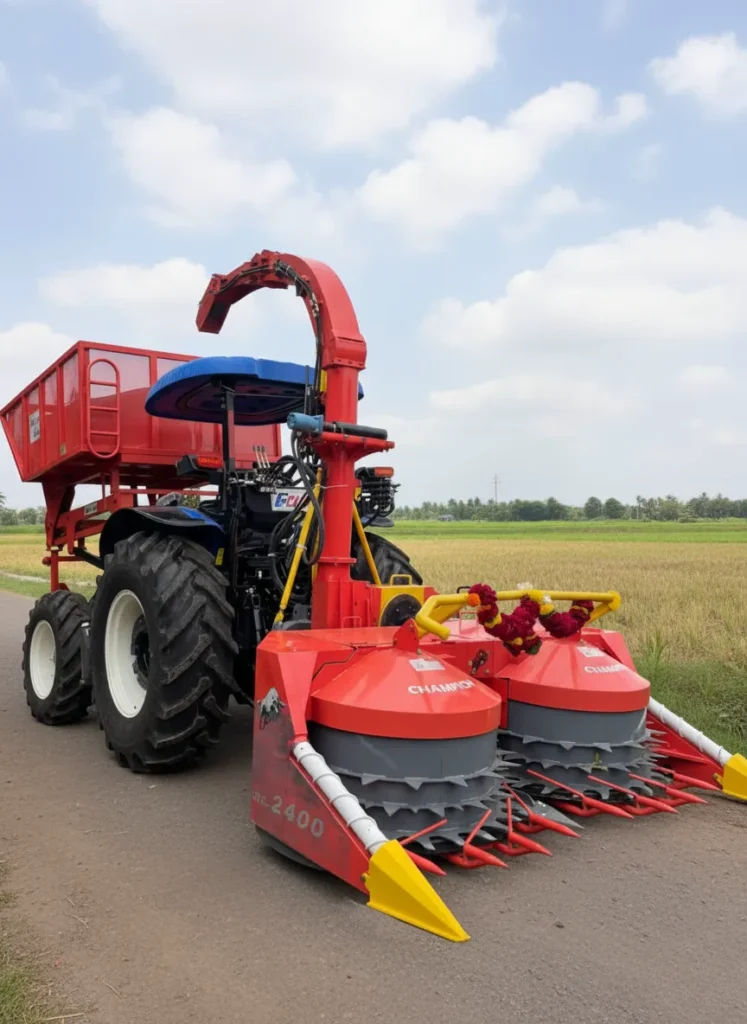
What Is a 2-Row Forage Harvester?
A 2-row forage harvester is typically an individual machine or harvesting attachment that is designed to work on 2 crop rows in a pass.
Compare the row spacing and crop conditions supported when inspecting equipment listed as “Forage Harvester 2 Row”. Two-row models may differ in feeding design, power requirements, chop adjustment, and output.
Before buying, ask:
- Does the header match your planting arrangement?
- Can it handle the expected crop height and density?
- What tractor specification does it require?
- How is chopped forage discharged?
- What output can it achieve under comparable field conditions?
Row count alone is not a good measure of daily productivity. Performance is also influenced by field layout, crop yield, operator skill and transport arrangements.
Small Farm Mini Forage Harvesters
A mini silage harvester could be attractive to farmers needing a compact machine for limited acreage or smaller fields. However, ‘mini’ is a description rather than a guarantee of suitability.
Check to see if the equipment is:
- A field harvester that cuts and chops standing crops.
- A stationary chopper that processes previously cut fodder.
- A compact tractor-operated harvesting attachment.
Even when sellers use similar names, these machines perform different tasks.
Is It Always Economical to Purchase a Mini Machine?
If you’re a small farm, you should compare ownership to hiring or sharing equipment.
A machine that is used only a short time each year may have a high ownership cost per tonne harvested. Where reliable contractors are available, it may be practical to hire, but availability during the required harvesting window needs to be considered.
Compare purchase or hire costs with fuel, labour, maintenance and expected annual usage.
Best Harvester for Farmers in India
The best harvester will depend on the output and workload of the farm.
| Farm requirement | Equipment to consider |
| Harvesting grain from wheat, paddy or maize | A suitably configured combine harvester |
| Harvesting whole-crop maize for silage | A compatible forage harvester |
| Chopping fodder has already been brought to the farm. | A suitable chaff cutter or stationary forage chopper |
| Limited seasonal forage acreage | Compare compact equipment with hiring or shared ownership. |
| Large forage harvesting workload | Assess higher-capacity equipment and the supporting transport system |
Choosing the Best Harvester for Silage
Begin with the crop and harvesting window. Then think of the machine as part of the total silage-making operation.
Focus on:
- Crop fit: Ensure the machine and header fit your crops.
- Chopping performance: During a demonstration, inspect the chopped material and discuss the available adjustments.
- Practical Capacity: Establish output under production conditions similar to your fields.
- Transport coordination: Make sure trailers and operators can keep material moving.
- Service support: Confirm availability of parts, maintenance requirements, and scheduled repairs.
- Total cost: Compare purchase, finance, fuel, labour and maintenance costs versus expected utilisation.
The best harvester for silage is the one that fits these criteria and lets you finish harvesting within the time you need.
Selecting a G-Class Forage Harvesting Solution
Forage harvesters and silage equipment for Indian agriculture. Farmers interested in its equipment should talk about their crop, tractor, acreage, and harvesting needs before choosing a model. G. Claas
Whether you are looking for information on a two-row machine, a compact model or any other silage harvesting system, please request model-specific specifications and a written quotation.
Please check the available configuration, compatibility, demonstration arrangements, warranty and service support before a purchase.
Also Read: ट्रैक्टर वाली कुट्टी मशीन क्या है? जानें इसके फायदे, कीमत और सही मशीन चुनने का तरीका
Conclusion
A combine harvester and a forage harvesters have different functions. Forage harvesters cut crop material for feed or silage and combine and collect the grain.
The desired output is the beginning of the right choice for the Indian farmers. Then compare crop compatibility, field conditions, tractor power availability, annual workload, and total operating cost.
Talk to G Claas about your forage harvesting needs, and learn about a machine that suits your crop and farm.
FAQs
1. What’s the difference between a forage harvester and a combine?
Ans: A forage harvester chops up crop material for feeding to livestock or making silage. The combine harvester is used to gather the grain from the crop.
2. Can a combine harvester be used in place of a silage harvester?
Ans: The standard grain combine cannot be replaced by the whole-crop silage harvester. They have different processing systems and different intended outputs.
3. What is a 2-row forage harvester?
Ans: It generally means the machine or attachment is intended to harvest two crop rows in a pass. Refer to the individual model for details on supported row spacing, compatible crops, and tractor requirements.
4. Is a mini silage harvester right for every small farm?
Ans: No. It depends on acreage, field access, crop type, power availability, and annual use. Some farms may find it more economical to hire or share equipment.
5. Can both machines harvest the same crop?
Ans: Yes. For example, maize can be harvested for whole-crop forage or for grain. The machine and harvesting approach depend on what you want to produce.