
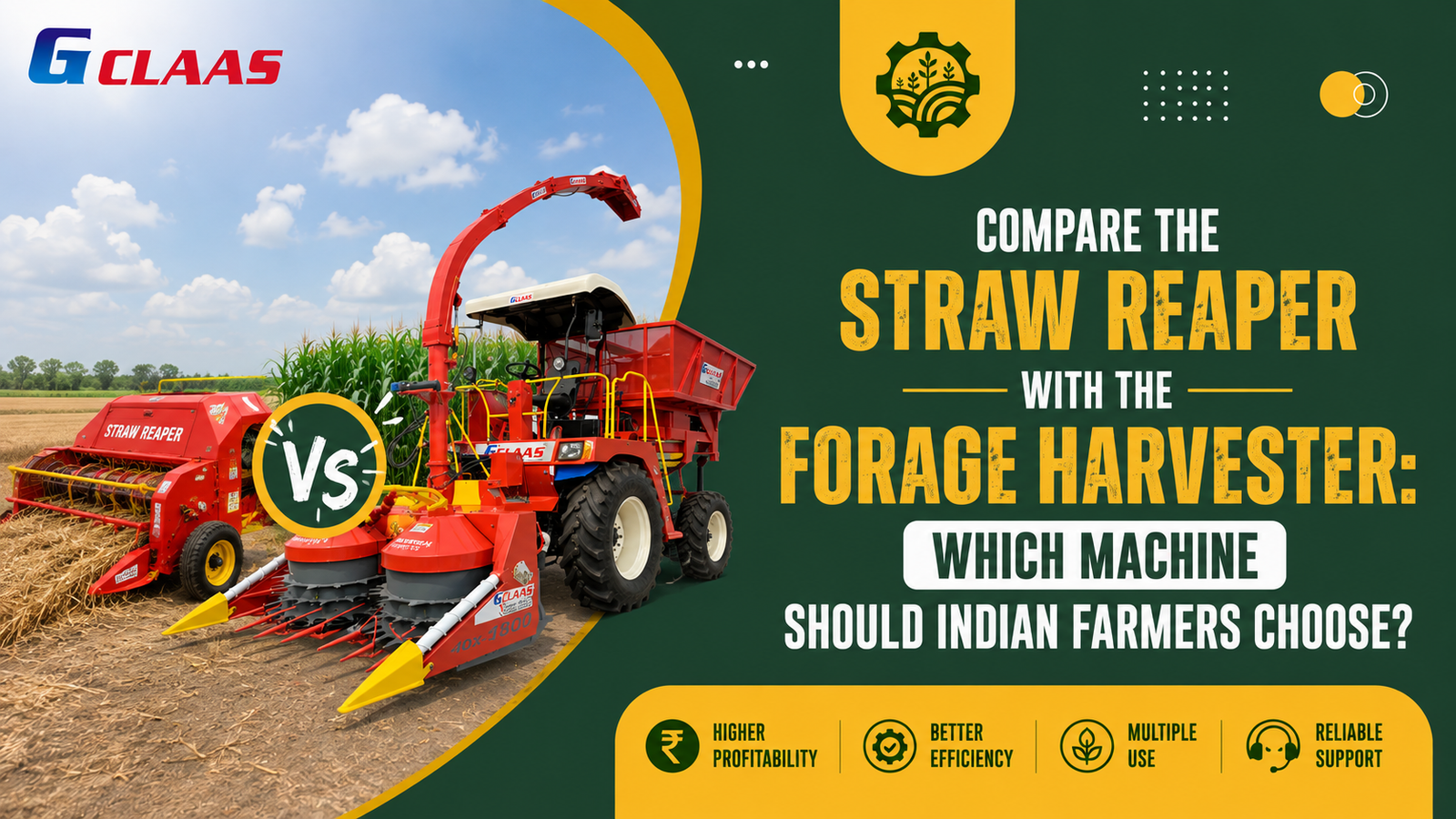
Agricultural mechanisation has changed the way Indian farmers conduct harvesting operations. Today, modern machines not only reduce dependence on labour but also allow farmers to enhance productivity, save time, and maximise the value of every crop. The straw reaper and forage harvesters are two of the most commonly used implements after crop maturity and are part of the many harvesting machines available. Both machines help to run the farm efficiently, but they are built for very different purposes.
Because both deal with crop residue, farmers tend to think of these machines as doing the same thing. However, it is important to understand their differences before investing. The machine you use will depend on the type of crop you have, whether you are a dairy farmer, or how you intend to use the material harvested.
At G. Claas, we empower Indian farmers with advanced harvesting solutions to make informed decisions. If you want to manage residue or produce high-quality silage, the right machine choice can increase efficiency and improve farm profitability.
What is the purpose of a straw reaper?
The Straw Reaper is mainly used after the grain is harvested by the combine harvester. Instead of leaving crop residue all over the field, the machine collects the leftover straw, cuts it into smaller pieces, and separates any leftover grain from the straw.
This machine is often used for harvesting crops such as the following:
- Paddy,
- Barley,
- Wheat
The processed straw can be fed to livestock as dry fodder, used as bedding material, or stored for later use. In areas where burning crop residue has become an environmental issue, straw reapers also help farmers to manage residue sustainably and productively.
On grain-producing farms, a straw reaper recovers valuable material which would otherwise be wasted and, at the same time, prepares the field for the next crop.
What is a forage harvester?
Unlike a straw reaper, a forage harvester is designed for harvesting green standing crops before they mature. This one cuts fresh fodder into equal-sized pieces instead of collecting dry residue. It can be used for making silage or feeding.
A forage harvester is normally used for crops such as the following:
- Maize,
- sorghum,
- Napier grass Oats
- Bajra hybrid fodder grass
Then the chopped fodder is dropped directly into a trailer so the farmers can take it away fast to store or feed.
This machine is a must-have for dairy farmers to produce nutritious silage to feed healthy livestock and increase milk production year-round.
Basic Differences between Straw Reaper and Forage Harvester
Both machines are used for harvesting, but they are based on totally different principles and are used for totally different purposes.
| Feature | Straw Reaper | Forage Harvester |
| Purpose | Collects and processes dry crop residue | Harvests green fodder crops |
| Crop Stage | After grain harvesting | Before full crop maturity |
| Output | Dry straw | Chopped green fodder |
| Main Use | Residue management | Silage production |
| Ideal Users | Grain farmers | Dairy and livestock farmers |
| Harvested Material | Dry straw | Whole green plant |
The primary difference is in the ultimate output. The straw reaper is meant to harvest dry residue, and the forage harvester is meant to produce high-quality green fodder for livestock.
What crops can each machine work with?
The kind of machine you select depends a lot on the crops you grow on your farm.
Reaper of Straw
The straw reaper is perfect.
- Wheat fields after combine harvest
- Paddy Residues
- Straw barley
- Other cereal crop remains
This helps farmers recover valuable straw and also provides a clean field for the next cropping cycle.
Forage Harvester (F/H)
A forage harvester is designed for.
- Corn Sorghum
- Napier grass Oats
- Bajra Green fodder crops
It is especially beneficial for dairy farmers who require a consistent, high-quality feed supply year-round.
Which Machine is Best for Dairy Farmers?
A straw reaper has a lot less value than a forage harvester for dairy farming.
Fresh chopped fodder is more nutritious than dry straw and is ideal for silage. Well-prepared silage helps in better digestion, increases milk yield, and provides balanced nutrition to cattle even in the absence of green fodder.
Dry straw collected by a straw reaper can still be used as roughage, but not as a replacement for nutrient-rich silage as the main feed source.
Farmers who are heavily reliant on livestock will find that investing in a forage harvester is a better long-term investment. It results in improved animal health and more dairy productivity.
Advantages of Using Modern Harvesting Equipment
Whether you prefer a straw reaper or a forage harvester, mechanisation provides a number of significant benefits over traditional harvesting techniques.
These machines help farmers to:
- Lower Labour is seeking
- Harvest quickly to finish
- Reduce crop losses
- Enhance operational efficiency
- Overall, lower harvesting costs
- Boost productivity
- More effective use of crop residues
- Boost farm profitability
Selecting the right machine means these benefits are in line with your farming goals.
How G-Class is Aiding Indian Farmers
Modern farm machinery gives the best results when it is backed up by reliable service and expert advice. At G Class, we are convinced that supporting farmers is more than just delivering machines.
“We are focused on ensuring farmers have access to reliable harvesting solutions that are made for Indian agricultural conditions and help them get better productivity.”
G Claas supports farmers to:
- High-performance harvesting machine
- Equipment for all crops and all sizes of farms
- – Ensured spare parts availability
- After-sales service is prompt.
- Operator Training & Technical Guidance
- Good dealer support in all of the farming areas
“Farmers should invest with confidence in technologies that improve efficiency and reduce operational costs with robust machines and reliable customer service,” says G Claas.
How to select the right machine
Farmers should take into account their specific farming needs before purchasing either machine.
Select a straw reaper if:
- Your main crop is wheat or paddy.
- You want straw recovery after the combine harvest.
- You need efficient residue handling.
- You want to cut down on stubble burning.
If you want a forage harvester:
- You are a dairy or livestock farmer.
- Usually, you grow maize or fodder crops.
- You make ensilage for cattle.
- Chopped green fodder should be of good quality.
Knowing your crop rotation and your long-term goals for the farm will guide your investment decisions.
Why it’s important to invest in the right machine
Investment in agricultural machinery is a long-term investment and directly affects productivity and profitability. You will reduce unnecessary spending and increase your overall efficiency by purchasing a machine that’s right for your farm operation.
A straw reaper helps grain farmers better utilise crop residue, while a forage harvester enables dairy farmers to create high-quality feed that promotes healthier livestock and improved milk yields.
Farmers can reduce manual labour, complete field operations on time, and prepare their farms more efficiently for future cropping cycles with the right tools.
Conclusion
A straw reaper and a forage harvester are both important agricultural machines, but they have different purposes. After harvesting the grain, there is a lot of dry crop residue to manage. A straw reaper is the best solution in this case. A forage harvester is used to harvest green fodder and make quality silage for the livestock.
The choice between the two is also more about your goals of farming than the specs of the machine. Grain farmers wanting to maximise their straw recovery will find a straw reaper of value, while dairy and livestock farmers will find a forage harvester of more value.
At G. Claas, we are dedicated to empowering Indian farmers to adopt the latest harvesting technologies to enhance efficiency, reduce reliance on labour, and foster sustainable agricultural development. By selecting the right harvesting solution, farmers can boost productivity today and establish a stronger, more profitable future for their farms.
Frequently Asked Questions (FAQ)
1. What is the difference between a straw thresher and a forage harvester?
Ans: A straw reaper is used to gather and process dry crop residue after harvesting the grain, and a forage harvester cuts and chops green standing crops for silage or livestock feed. The two machines are built for different agricultural uses and are not interchangeable.
2. Which is the best machine for a dairy farm?
Ans: A forage harvester is the better choice for dairy farms. It cuts green fodder and makes uniform chopped silage. This enhances feed quality, improves the health of cattle, and can help in increasing milk production.
3. Can a straw reaper be used to make silage?
Ans: Nope. A straw reaper is used to pick up dry straw left over from the combine harvest. For silage, you need fresh green fodder harvested at the right stage – that’s why a forage harvester is the right machine for silage production.
4. What crops can be harvested with a forage harvester?
Ans: A forage harvester is used for harvesting green fodder crops like maize, sorghum, Napier grass, oats, bajra, and other forage crops. It cuts the crop into consistent pieces to make feeding or silage storage easier.
5. What’s the difference between a straw reaper and a forage harvester?
Ans: It depends on your farming needs and your choice. If you want to manage crop residue after harvesting wheat or paddy, a straw reaper is the right choice for you. If you grow fodder crops for dairy or livestock and need high-quality silage, then a forage harvester is the better investment.