
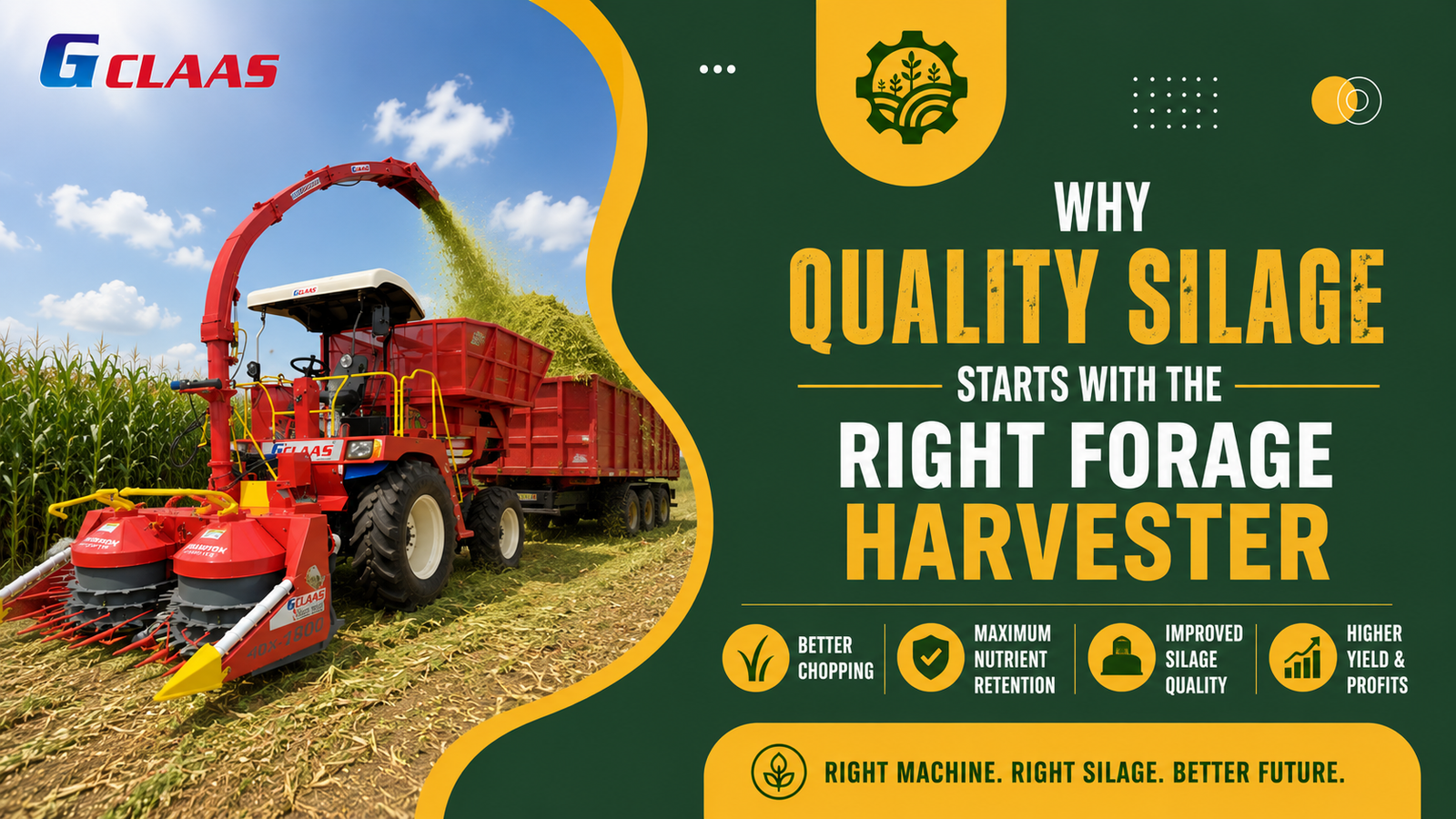
Producing high-quality silage is one of the best ways for dairy farmers to ensure a consistent supply of nutritious feed all year round. Good silage helps keep cattle healthy, boosts milk production, cuts down on feed waste, and reduces overall feeding costs. However, the quality of silage is much more than the crop itself; how the silage is harvested is also important to nutritional value and storage life.
This is where selecting the proper forage harvester is key. A properly designed forage harvester cuts, chops, and conditions the green fodder to the proper particle size to allow for proper fermentation. Investing in reliable harvesting equipment is not only about improving efficiency; it’s about protecting the quality of every load of fodder you harvest.
Quality silage is a must for modern dairy farming – we know that at G Claas. Our advanced forage harvesters are built to assist Indian farmers in harvesting fodder in an efficient manner, ensuring the nutritional value is retained from the field to the silage pit.
Also Read: Forage Harvester vs. Combine Harvester: Which Machine is Right for Your Farm?
The Importance of Silage Quality
Silage is green fodder preserved by controlled fermentation under airtight conditions. The good silage secures the feed availability in the dry season when fresh fodder is not available, preserves the nutrients, and provides balanced nutrition to the livestock.
There are many benefits of good-quality silage:
- Improves the quantity and quality of milk
- Helps keep cattle healthy
- Lowers feed deficit over the year
- Reduces feed wastage
- Reduces the total cost of feed
- Consistent nutrition regardless of seasonal variations
Poor quality silage, on the other hand, may result in nutrient loss, deterioration, decreased feed intake, and decreased dairy productivity.
Forage Harvester in Silage Production: Its Role
A forage harvester is a machine used to cut green crops and chop them into uniform pieces for use in silage preparation. Modern forage harvesters perform cutting, chopping, and feeding operations in a single pass, unlike manual harvesting methods.
The machine harvests crops like the following:
- Sorghum Maize
- Oats Napier grass
- Bajra hybrid fodder
Uniform chopping is important because it provides better compaction inside the silage pit and therefore less trapped air, which gives the right conditions for fermentation.
Uniform Chop Length Enhances Fermentation
One of the most important factors in producing quality silage is consistent chop length.
When the fodder pieces are too long:
- There are still air pockets in the silage pit.
- The fermentation is not regular.
- The spoilage gets worse.
- The quality of the feed goes down.
If the fodder is mown too short:
Nutrient loss.
Animals might eat less effective fibre.
A good quality forage harvester chops fodder evenly, which helps farmers to get the right balance to have good fermentation and better feed quality.
Harvesting at the Right Time Preserves Nutrients
The nutritional value of the feed depends very much on harvesting at the right stage of maturity.
Modern forage harvesters allow farmers to harvest quickly once the crops reach their ideal moisture level.
This helps to keep:
- Energy content Protein content
- Digestive system
- The level of sugar
Harvesting delays can result in reduced nutrient value and negative effects on silage quality.
Farmers need efficient machinery, such as a Claas G, to ensure that harvesting is done in the right time frame and to safeguard the quality of their fodder.
Speedier Harvesting Cuts Crop Losses
The manual method is labour-intensive and often takes several days to complete, especially on larger farms. During this time, crops can lose moisture, become over-mature, or be damaged by weather.
A forage harvester significantly decreases harvesting time by:
- More acres in less time
- Field Loss Reduction
- Reducing dependence on labour
- Enhance operational efficiency
The faster the harvest, the more nutrients of the crop are saved for silage.
Good compaction equals good silage.
Proper compaction is one key to successful silage storage.
Fodder chopped evenly packs more densely into silage pits or bunkers, squeezing out the trapped oxygen, which can cause spoilage.
Good compaction gives the following:
- Enhanced fermentation
- Less dry matter loss
- less mould growth
- Increased storage life
- Better feeding quality
The uniformity you achieve with a modern forage harvester makes compaction easier and more effective.
Supports Increased Milk Production
Good silage has a direct bearing on the dairy herd’s output.
Cattle fed with well-fermented silage usually undergo the following:
- Helps with digestion
- Better feed intake
- Increased milk yield
- Higher milk fat content
- Enhanced reproductive performance
For dairy farmers, investing in quality harvesting equipment is an investment in the long-term profitability of the farm.
How G-Claas Helps Farmers Produce Better Forage
At G. Clarks, we understand how quality silage begins with dependable machinery. “Our forage harvesters are designed to deliver consistent performance in a wide range of crops and farm conditions across India.
We support farmers by offering the following:
- Efficient chopper systems.
- Building heavy-duty machines
- Field performance reliability
- Simple to use
- Minimal maintenance requirements
- Spare parts are readily available
- Professional after-sales service
- Training & technical assistance
Our commitment is more than just supplying machinery. We work together with farmers so they can get more harvesting efficiency and better quality silage year after year.
Selecting the Right Forage Harvester
When choosing a forage harvester, there are a number of factors to consider.
Farm Size
Small farms may find compact or tractor-mounted units useful, while larger operations generally require higher-capacity machines.
Type of Crop
Select a machine suitable for the fodder crops you plant, for example, maize, sorghum, or Napier grass.
Harvest Capacity
Think about how much fodder you need to harvest each season and choose a machine that meets your productivity requirements.
Support Services
Dependable after-sales service and parts availability to keep your machine operating during harvest.
By working with an experienced agricultural equipment supplier such as Claas, you’ll be able to find the right solution for your farm.
Also Read: Forage Harvester Price in India (2026): Types, Features & Buying Guide
Conclusion
Good silage begins long before the fodder is put in the pit. It begins in the field with the correct harvesting equipment. With a reliable forage harvester, you’ll get even better chopping, faster harvesting, better compaction, and improved nutrient preservation—all leading to a better quality silage.
For dairy farmers, this means healthier cattle, reliable feed availability, better milk production, and greater profitability all year round.
At G Claas, we are proud to support Indian farmers with reliable forage harvesting solutions that enhance the efficiency and productivity of silage preparation. Selecting the appropriate forage harvester can help farmers lay a better foundation for sustainable dairy farming and long-term agricultural success.
Frequently Asked Questions (FAQs)
1. Why is the forage harvester important in producing quality silage?
Ans: The forage harvester cuts the green fodder into uniform pieces, which makes it easier to compact and to ferment properly. This saves nutrients, reduces spoilage, and creates high-quality silage for livestock.
2. What crops are best suited for producing silage?
Ans: The common crops used for silage are maize, sorghum, napier grass, oats, bajra, and other green fodder crops. These crops are very nutritious if harvested at the right time.
3. How does chop length affect the quality of silage?
Ans: Uniform chop length improves compaction and air removal in the silage pit. This provides better conditions for fermentation, which in turn reduces spoilage and maintains the nutritional quality of the fodder.
4. How does a forage harvester increase the productivity of a dairy farm?
Ans: A forage harvester can help improve cattle nutrition by producing uniform, high-quality silage, promoting increased milk production, less wastage of feed, and less labour at harvest.
5. Why Choose G Claw Forage Harvesters for Farmers?
Ans: G. Claas provides reliable forage harvesters for Indian farming conditions, supported by dependable after-sales service, technical support, strong construction, and efficient harvesting performance to help farmers produce superior-quality silage.