
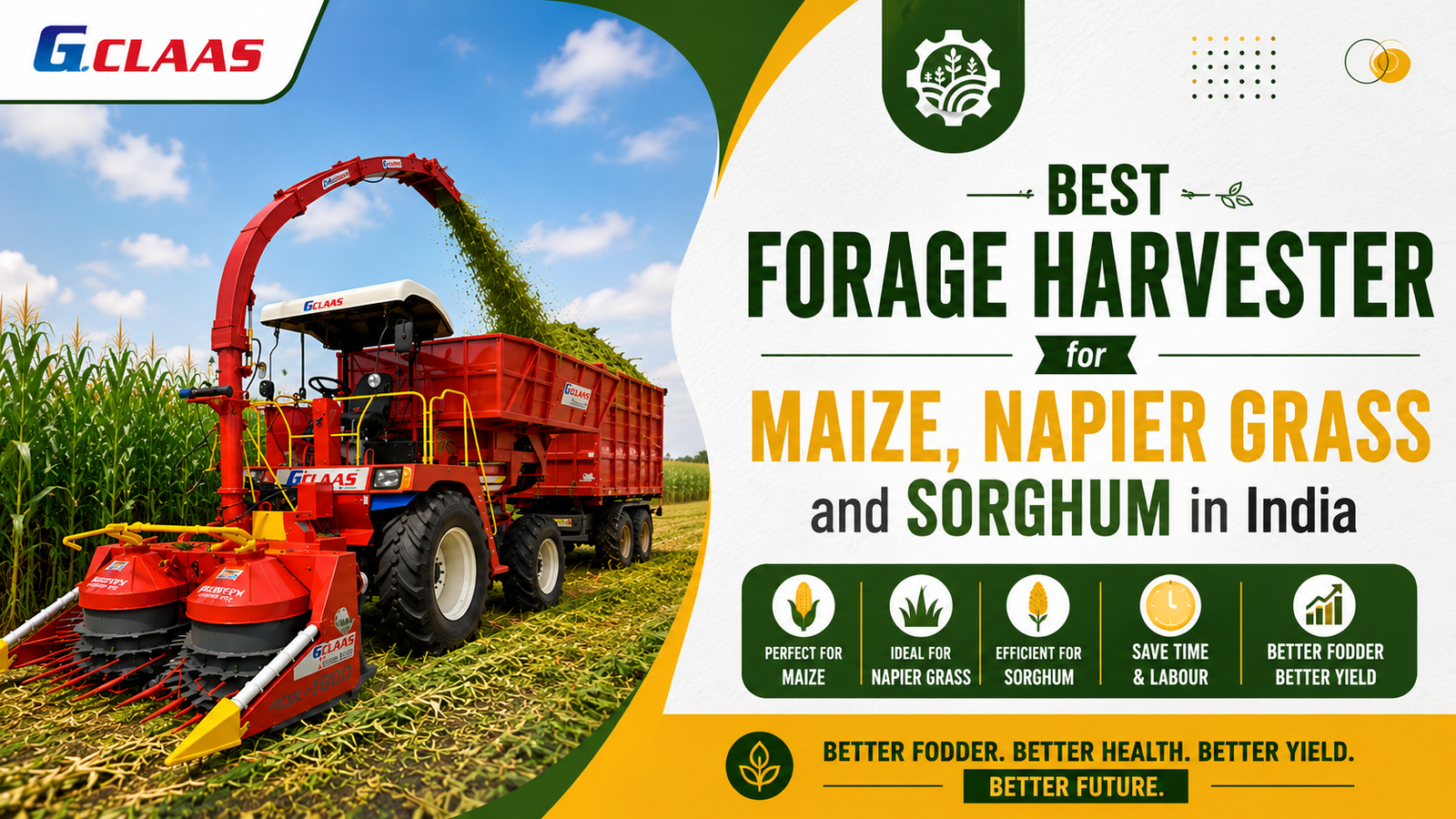
Good-quality silage production begins with harvesting fodder at the right stage and processing it properly. Indian dairy farmers use maize, Napier grass and sorghum extensively as green fodder and silage. But picking these crops by hand can be very laborious and time-consuming.
A good forage harvester does the hard work for you, efficiently cutting and chopping fodder and giving a uniform chop size. This helps farmers in preparing fodder for better compaction and fermentation and reduces the harvesting time and crop losses.
The right forage harvester for maize, Napier grass and sorghum should provide farmers in India with reliable crop intake, uniform chopping, good field capacity, easy operation and reliable after-sales support.
Also Read: Forage Harvester vs. Combine Harvester: Which Machine is Right for Your Farm?
Why This Forage Harvester Is Important
The efficiency and quality of the chopped fodder directly depend on the performance of a forage harvester.
A proper machine can assist the farmer:
- Get more fodder in less time
- Less reliance on manual labour
- Get a more consistent length of chop
- Reduce losses in harvesting of crops
- Better fodder handling and transport
- Promote better silage compaction
- Stabilise the performance of the harvest
The harvesting of forage is time-sensitive, as the fodder has to be harvested at the right stage of maturity and moisture. A machine that can work well during this harvest window can help farmers capture more of the feeding value of the crop.
Top Maize Forage Harvesters
Maize is one of the most important crops for silage production due to its energy content and suitability for ensiling. However, the proper maize harvesting machine should be capable of cutting the standing crop and producing the chopped material with a high level of uniformity.
A good maize forage harvester should provide:
- Efficiency of crop uptake
- Uniform chop length
- Smooth flow of crop
- Dependable chopping performance
- Maize harvesting attachments for maize harvesting
- High field productivity
The CLAAS JAGUAR series, for example, is designed for forage harvesting with high throughput and can be equipped with ORBIS maize front attachments. “The JAGUAR range is designed for a wide range of forage harvesting applications, with the JAGUAR 800, 900 and 1000 each offering different performance capabilities,” says CLAAS.
Independent DLG testing was also carried out on the CLAAS JAGUAR 960 to verify its functionality and quality of work in silage maize, including chop-length distribution and kernel processing.
Best Napier Grass Harvester for Forage
Napier grass is a high-yielding perennial fodder crop for dairy feeding. Napier is a producer of large quantities of green matter, and for farmers with larger fodder requirements, efficient harvesting is important.
For Napier grass, farmers should be looking for a forage harvester that:
- Feeds long grass material smoothly
- Steadily cutting away
- Good crop flow performance
- Low risk of blockage
- Easy to maintain
- Appropriate capacity for the farm
The cutting and chopping system should be able to consistently process the crop rather than leave too much long material. Consistent chopping also makes the harvested fodder easier to transport, to handle, and to compact when making silage.
Best Sorghum Forage Harvester
Sorghum is another important fodder crop for feeding and silage. The tall, dense crop structure demands a good intake and dependable chopping by the harvesting machine.
When picking a sorghum forage harvester, keep in mind:
- Density and height of the crop
- Harvesting capacity needed
- Setting of chop length
- Crop flow design
- Requirements for engine or tractor power
- Availability of service and spare parts
A well-matched machine can help farmers to harvest sorghum quickly and maintain consistent chopped-fodder quality.
G Claas Harvesters For Indian Farmers |
G Claas sells forage harvesters for Indian farming needs, especially for maize, Napier grass and other fodder crops, to farmers looking for a forage harvester in India. Its website says its machines are designed for crops such as maize, Napier grass, bajra and other fodder crops and have features to save labour, speed up harvesting and make the machines easy to operate.
The company also focuses on field service, warranty support and availability for Indian farmers. These factors are critical because harvesting equipment needs dependable support during a short and key harvesting window.
Key Features to Look For When Buying a Forage Harvester
When farmers buy a forage harvester, they should consider more than just the purchase price.
1. Compatibility of Crops
Ensure that the machine is appropriate for your crops. A machine intended for maize might need different attachments or settings than one used largely for grass crops.
2. Length of chop
A uniform chop length is a key element for silage making. Look for a machine that allows you to adjust the chop length for different fodder crops and feeding requirements.
3. Capacity for Harvesting
Consider the total area and volume of fodder to be harvested. A machine that is not big enough can lengthen harvesting and increase the risk of crop losses.
4. Crop flow
A smooth crop flow helps to keep harvesting performance consistent and can help reduce interruptions caused by uneven feeding or blockages.
5. User Friendliness
Ease of machine operation can reduce operator fatigue and help maintain consistent harvesting performance during long working hours.
6. Spare parts and maintenance
Be sure to consider the availability of spare parts and technical support before buying. There is a narrow seasonal window when the harvesting equipment must keep running.
Maize vs Napier Grass vs Sorghum: What Should You Choose?
| Crop | Important Harvester Requirement | What to Consider |
| Maize | Efficient intake and chopping | Maize attachment, chop length and kernel processing |
| Napier Grass | Smooth grass feeding | Crop flow, chopping consistency and blockage prevention |
| Sorghum | Strong crop intake and chopping | Crop density, capacity and machine configuration |
The best forage harvester is therefore not necessarily the machine with the highest horsepower. It is the machine that matches the farmer’s crop, acreage, harvesting schedule, available power and budget.
Benefits of Using a Forage Harvester for Silage
Using a suitable forage harvester, there are many advantages in the whole silage-making process.
Harvesting Faster
Mechanical harvesting can harvest a significantly greater area in a shorter period compared to manual cutting.
Less dependence on Labour
Farmers can cut down on their dependence on large numbers of seasonal workers during peak harvest times.
Steady Chopping
Uniform-sized chopped fodder is easier to compact and provides conditions conducive to silage fermentation.
Harvesting Losses Reduced
Harvesting faster will help reduce losses from delayed harvesting, weather exposure, and crop deterioration.
Better Farm Efficiency
Faster harvesting and more efficient fodder handling can improve the efficiency of the whole dairy and livestock operation.
How to choose the best forage harvester in India
Ask yourself this before you buy.
- Which crops will you harvest most of?
- How many acres to cut?
- What is the fodder requirement per season?
- What size chop do you want?
- Is the machine tractor-mounted, tractor-operated, or self-propelled?
- What source of power is at hand?
- How easy is routine maintenance to do?
- Are spare parts easily available?
- Do you have technical and field service in your region?
- Does the machine work with your harvesting budget?
A compact solution may be more practical for smaller farms, while larger dairy farms and custom-harvesting contractors may prefer machines with greater capacity.
Why G Claas should be considered for fodder harvesting
G Claas has its forage harvester targeted at Indian farmers and lists maize, Napier grass, bajra and other crops as the applications for its machines. The company also touts features such as Japanese technology, labour savings, easy operation and field service.
When farmers are comparing machines, the most important thing should be how well the equipment fits their real crop conditions and harvesting needs, and not just simply choosing a machine on specifications.
Also Read: Forage Harvester Price in India (2026): Types, Features & Buying Guide
Conclusions
The best forage harvester for maize, Napier grass and sorghum in India is one that provides consistent chopping, reliable crop intake, adequate harvesting capacity and dependable support to the farmer’s specific operating conditions.
Maize requires efficient crop processing and appropriate harvesting attachments, and Napier grass and sorghum require reliable crop feeding and chopping performance. Selecting a machine that can efficiently handle the crops you grow on your farm can help reduce labour, shorten harvesting time and support better silage preparation.
For Indian dairy and fodder farmers, buying the right forage harvester is not only about mechanising harvesting. It’s about improving the efficiency of the whole process of converting fodder into feed and building a more reliable system for feeding livestock.
FAQs
1. Best Forage Harvester for Maize in India?
Ans: An ideal maize forage harvester should be able to provide efficient intake of the crop, consistent chop length, and appropriate maize harvesting attachments. The acreage and volume to be harvested on the farm should dictate the required machine capacity.
2. Can you use a forage harvester for Napier grass?
Ans: Yes. Forage harvesters are available for grass and other green fodder applications. It should ensure smooth feeding of the crop and uniform chopping for the type and quantity of Napier grass being harvested.
3. Can sorghum be cut with a forage harvester?
Ans: Yep. Sorghum can be harvested with forage harvesting equipment. Farmers should consider crop density, machine capacity, crop-flow performance and required chop length when deciding on a machine.
4. What is the best length of chop for silage?
Ans: The ideal chop length varies according to the crop, moisture level, feeding system and silage-management method. Farmers should follow the recommendations for each crop and change the machine accordingly; do not use one setting for every crop.
5. Why does a forage harvester save on labour costs?
Ans: A forage harvester mechanises the cutting and chopping of fodder, so farmers can harvest much more fodder with fewer workers than manual harvesting methods.