
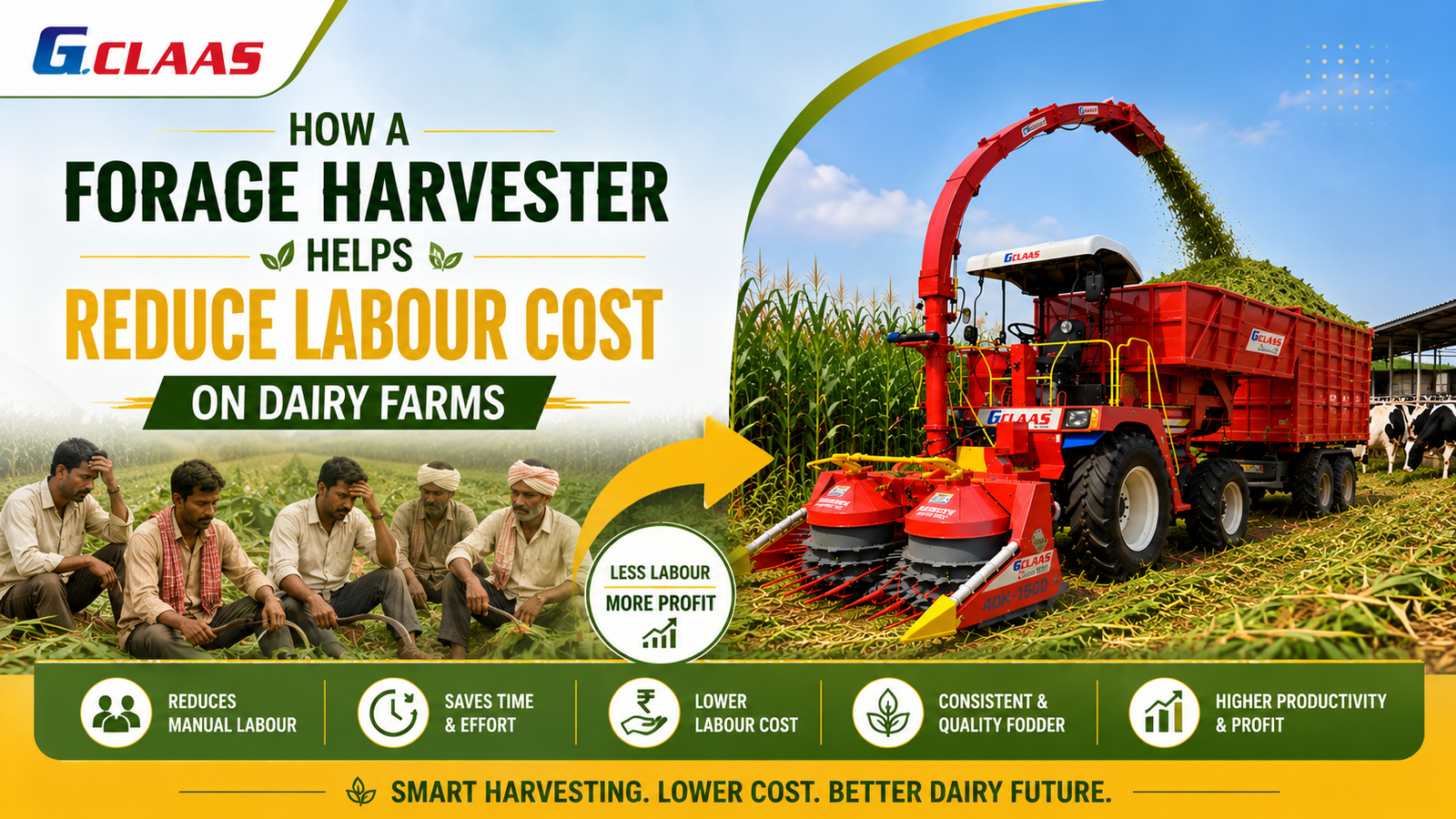
Labour is one of the biggest operating expenses for many dairy farms, particularly in the fodder harvesting season. Manual cutting, collecting, chopping, loading, and transportation of green fodder may require several workers and many hours of work. Dairy farms are expanding, and relying on manual labour alone can make fodder management a costly and difficult exercise to manage.”
A forage harvester mechanises important harvesting operations and reduces this pressure. Farmers can use a suitable forage harvesting machine to cut and chop fodder faster and more consistently instead of using multiple workers for these jobs.
For dairy farmers growing maize, Napier grass, sorghum, oats and other green fodder crops, investing in the right forage harvesters can improve harvesting efficiency and reduce dependence on seasonal labour.
Also Read: Compare the Straw Reaper with the Forage Harvester: Which Machine Should Indian Farmers Choose?
Why Labour Costs Are Important In Dairy Farming
Activities such as feeding cattle, cleaning sheds, milking, managing fodder and maintaining farm equipment require labour throughout the year in dairy farming. During the harvesting of fodder, the amount of labour required can increase dramatically.
Manual fodder harvest may entail:
- Collection of standing crop
- Collecting the harvested fodder
- Loading or hauling the crop
- Cutting the fodder
- Transporting to feeding or silage area
- Fodder for storage preparations
If all these activities are performed manually, harvesting may take several days depending on the size of the farm and availability of workers.
A forage harvester is a machine that combines important harvesting procedures into a mechanised process, allowing farmers to complete the job in less time.
How a Forage Harvester Reduces Labour Costs
1. Speedier Fodder Cutting
Cutting by hand can be a tedious job, especially for dense crops like maize, Napier grass and sorghum.
A forage harvester can cut fodder continuously in large amounts, allowing the farmer to cover more field in less time.
This means fewer workers are required to do the cutting operation.
2. Mechanical Chopping
The fodder is sometimes manually cut and then has to be taken to another location for chopping. This involves more handling and labour.
The harvesting process involves a forage harvester cutting and chopping. The machine produces chopped fodder which can be fed into a trailer or other collection system.
This cuts down the manual work of chopping and cutting the crop.
3. Reduced Dependence on Seasonal Labour
Finding reliable agricultural workers during peak harvest times can be difficult. Labour availability may also vary from region to region.
Mechanisation allows dairy farmers to have more control over their harvesting schedule.
Farmers can harvest with a trained machine operator and the necessary support staff, rather than wait for a large group of workers to become available.
4. More Acres Harvested Daily
One of the main advantages of mechanised forage harvesting is higher productivity in the field.
If it cuts down on harvest time, farmers can:
- Complete harvest within the necessary crop window
- Cut the number of labour days.
- Reduce delays.
- Fewer weather-related crop losses
- Make an early start on silage fodder.
The actual productivity is a function of the machine, crop condition, field size, tractor or engine power, operator skill, and harvesting setup.
Labour saving apart from chopping and cutting?
The labour-saving advantage of a forage harvester is not confined to the field.
Manual handling during fodder preparation can be reduced with a good harvesting system.
Old Manual Process
- Cutting → Harvesting → Transporting → Chopping → Loading → Transporting → Silage Making
Each stage may require more workers.
Mechanised Process
- Chopping → Collection/loading → Transport → Silage preparation → Harvest
The number of separate manual operations is reduced by a forage harvester by combining the harvesting and chopping operations.
Decreased Labour Input for Silage Preparation
For silage production, fodder has to be harvested, chopped, transported, and compacted in a suitable time frame.
Late harvesting can impact the quality of the fodder, especially if the crop remains in the field longer than desired.
A forage harvester is a machine that speeds up the harvesting process and produces chopped material in a uniform size. This can help make the next stages of silage preparation easier to organise.
Efficient chopping also helps get the harvested material through the transportation and storage process with less manual handling.
Improved Use of Farm Labour
The reduction of labour requirements does not mean a reduction of workers.
Mechanisation rather makes it possible for farmers to use the available labour more efficiently.
For example, workers may focus on:
- Feeding animals
- Animal housing
- Management of the shed
- Preparing the silage pit transport
- Equipment to monitor
- General farm upkeep
Meanwhile, the forage harvester takes care of the repetitive cutting and chopping work.
This can increase the overall productivity of the dairy farm labour force.
Labour savings: a pathway to better economics on dairy farms
The economic benefit of a forage harvester is a function of several factors, such as the size of the farm, the area under crops, labour costs, the cost of the machine, fuel consumption, maintenance and annual use.
But farms that have a high requirement for fodder will get a reduced number of labour days and a quicker harvest.
Economic benefits may include:
- Less hand harvesting spending
- Less reliant on seasonal workers
- Faster harvesting.
- Less risk of late harvesting
- Better use of the workers available.
- More harvesting capacity
Farmers should work out the economics for their own acreage and annual harvesting requirements and not just apply a fixed percentage of labour savings.
Forage harvester for corn, napier and sorghum
Different fodder crops have different harvesting properties. So, a machine should be chosen as per the crops grown on the farm.
Corn
Corn is often used for silage. Effective harvesting and uniform chopping can enable farm owners to process large quantities of crop during the appropriate harvesting period.
Napier Grass
Napier grass can produce large amounts of green biomass. Mechanised cutting and chopping can go a long way in reducing the manual work involved in handling this crop.
The sorghum sorghum
Sorghum can also be used as green fodder and silage. A suitable forage harvester can be more effective for harvesting tall and dense crops than manual harvesting.
How to Choose the Right Forage Harvester to Save Money
Buying the biggest machine isn’t always the best way to cut costs. The machine must suit the real needs of the farm.
Farm Size
The harvesting capacity of a small dairy farm may not be comparable to that of a large commercial dairy farm.
Annual Fodder Need
Determine the quantity of fodder to be harvested during the year and select the machine of suitable capacity.
Type of Crop
Make sure the machine is designed for the crops you grow, like maize, Napier grass, and sorghum.
Power Consumption
Tractor-Operated Machines – Make sure the tractor available has enough power for the equipment chosen.
Parts & Service – Spare
“Servicing and parts availability is also important. If equipment is down during harvest, it can increase costs and delay harvest.”
Training of Operators
Trained operators can help you to keep the machine performing efficiently, reduce unneeded downtime, and operate the equipment safely.
G Claas Forage Harvesting Solutions for Indian Farmers
G Claas is a specialist in forage harvesting machines for Indian farming operations. Its machines are marketed for crops such as maize, Napier grass, bajra and other green fodder crops.
The value of a forage harvester is not only in its cutting capacity for farmers contemplating mechanisation. When considering the total cost of ownership, consider the combination of harvesting speed, chopping consistency, machine reliability, service support and ease of operation.
Should I Invest in a Forage Harvester?
A forage harvester is not always the most economical alternative for a small farm where acreage of fodder is limited. Sometimes it’s easier to hire someone to do the harvesting or get the work contracted out.
Larger dairy farms, commercial fodder producers and farmers who harvest large quantities of green fodder each season can benefit more from either owning or regularly employing a forage harvester.
The decision should be made based on:
- Total annual area harvested.
- Current prices of labour
- Local availability of labour
- Cost of machine purchase or hire
- Maintenance and fuel costs
- Anticipated machine utilisation
- Annual requirement of fodder
You can do a simple cost comparison to determine whether ownership, custom hiring or a shared-machine model is best.
Also Read: Why Quality Silage Starts with the Right Forage Harvester
Conclusion
Mechanisation of cutting and chopping of green fodder by a forage harvester helps dairy farms reduce labour costs. It enables farmers to harvest more fodder in less time, reduce repetitive manual work and use their available manpower for other important dairy operations.
On farms producing maize, Napier grass, sorghum and other fodder crops, the correct harvesting machine also helps improve the organisation of silage preparation and reduce delays during critical harvesting periods.
The best investment depends upon the size of the farm, the requirement of fodder, the type of crop, the labour cost and the frequency of harvesting. Careful consideration of these factors can lead to forage harvesting machinery being an integral part of a more efficient and cost-effective system of dairy farming.
FAQ’s Frequently Asked Questions
1. How does a forage harvester lower labour costs?
Ans: A forage harvester is a machine that mechanises the important operations of cutting and chopping. This lowers the number of workers and labour hours required compared to fully manual fodder harvesting.
2. Can I use a forage harvester for maize and Napier grass?
Ans: Yes, forage harvesting equipment can be used for crops like maize and Napier grass if the machine and harvesting setup are suitable for the crop.
3. Are farm workers unneeded with a forage harvester?
Ans: No. It does reduce the amount of manual harvesting work but still requires operators and workers for things like transportation, silage preparation, livestock care, and machine management.
4. Does it make economic sense to buy a forage harvester for a small dairy farm?
Ans: It depends upon annual fodder acreage, labour cost and machine utilisation. In some cases, for smaller farms, custom hiring or shared equipment may be more economical than purchasing a machine.
5. What are the main labour-saving advantages of a forage harvester?
Ans: The main benefits are faster cutting, mechanised chopping, fewer manual handling operations, less dependence on seasonal labour, and faster completion of fodder harvesting.