
For dairy farmers, high-quality silage is an effective way to ensure a reliable supply of nutritious fodder throughout the year. However, the manual harvesting of green fodder is time-consuming, labour-intensive, and difficult to manage when large quantities of crops need to be harvested within a short period.
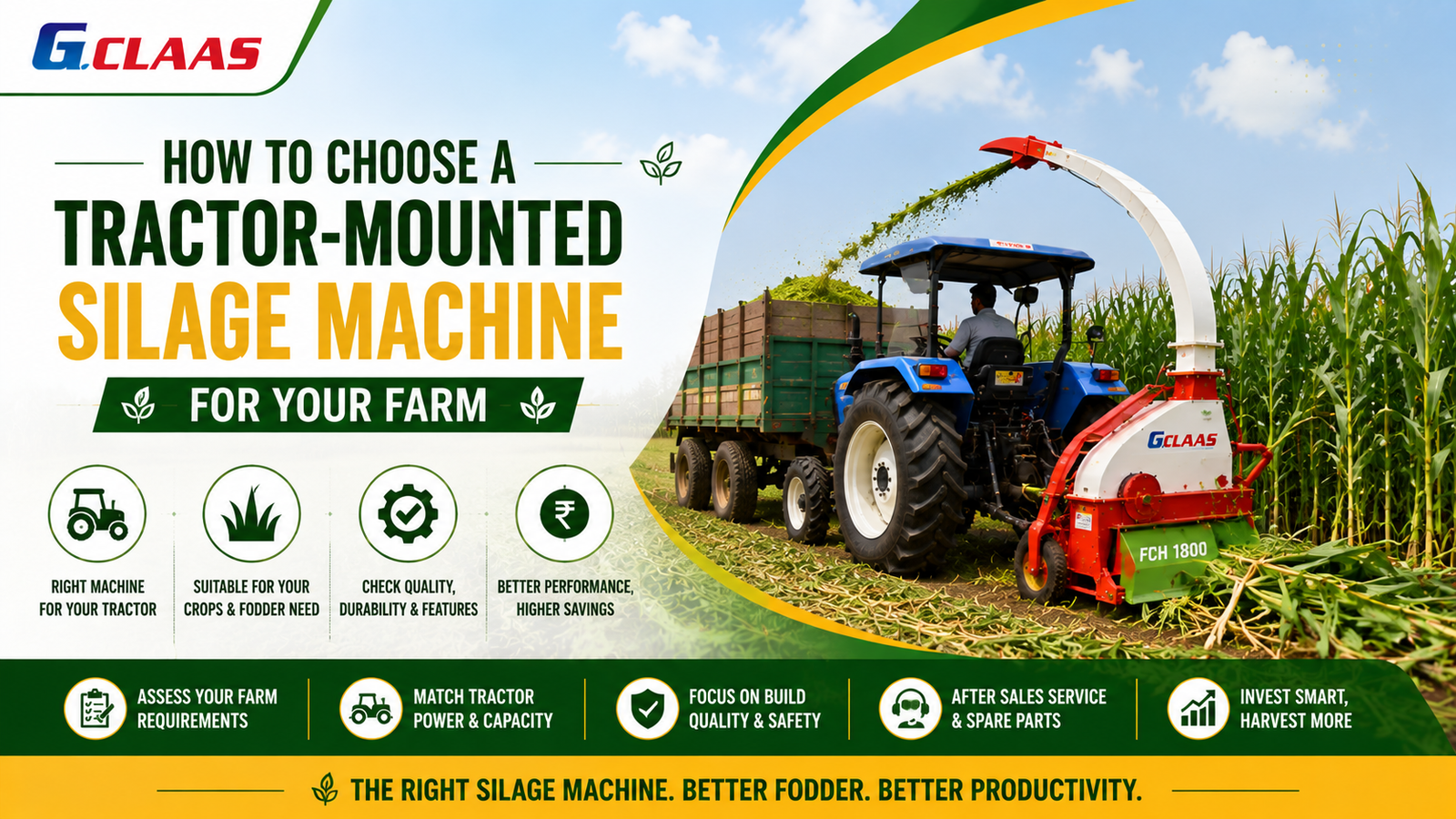
A tractor-mounted silage machine can help speed up the process and make it more efficient. These machines run on tractor power and can be used to cut and chop crops like maize, Napier grass, sorghum and other green fodder. Depending on the machine design, the chopped material can also be discharged directly into a trailer for easier collection and transport.
The right choice for farmers looking at a forage harvester or silage machine depends on a number of things, including tractor power, crop type, farm size, harvesting capacity, chop length, maintenance and after-sales support.
Also Read: Increase Dairy Farm Productivity with Modern Forage Harvesting
What is a silage machine on a tractor?
A tractor-mounted silage machine is a forage-harvesting implement mounted on a tractor, typically driven by the tractor’s PTO and mounting system. Used for chopping and harvesting green fodder for silage or for direct feeding to livestock.
Forage harvesters typically do cutting and chopping in one continuous operation. Some machines also dump the chopped material directly into a trailer, reducing manual handling.
For farms with a suitable tractor and moderate harvesting requirements, tractor-mounted machines are a practical proposition when compared with self-propelled forage harvesters.
Why Select a Tractor-Mounted Silage Machine?
The main advantage is that the tractor provides the power required to run the harvesting equipment. This can make the installation easier for farmers who already have a compatible tractor.
Main benefits are:
- Reduced reliance on manual labour
- Faster cutting of fodder
- Continuous cutting
- Better use of an existing tractor.
- Less demanding feed collecting
- Less complicated equipment than a self-propelled machine.
- Suitable options for small and medium farms
For instance, G Claas, for example, supplies forage harvesting equipment to Indian farmers, with applications including maize, napier grass, bajra and other fodder crops. The company also claims easier operation and field service support and reduced labour.
1. Look at your tractor’s PTO power.
“The first is to ensure your tractor can safely and efficiently operate the silage machine you have selected.
Forage harvesters vary in their power requirements. For example, there are tractor-mounted machines out there that require tractors with horsepower ranging from around 35 HP to 50 HP, while other models require much more horsepower.
Don’t choose a machine just by the tractor engine’s horsepower. Check the manufacturer’s recommended PTO horsepower, hydraulic needs, PTO speed, and mounting requirements.
Please make sure, before buying:
- Tractor PTO HP
- PTO speed requirement
- Compatible with three-point hitch
- Hydraulic needs
- LIFTING CAPACITY TRACTOR
- Tractor weight and stability
- Suggested operating speed
Poor performance, excess loading, and unnecessary downtime can result from a machine that is too demanding for the tractor.
2. Think about the Crops You Want to Harvest
Not every silage machine is adapted to every crop. When you purchase, the crop type should be one of the biggest things you consider.
CORN.
Maize is widely used for silage production. The maize machine should intake the crop very well and chop it uniformly.
Napiergrass
Napier grass yields large quantities of green biomass. The machine must be able to easily pass through long and dense grass without frequent clogging.
Sorgho
Sorghum can be tall and dense, so reliable crop feeding and chopping performance is important.
Pearl Millet and Other Forage Crops
Some machines are used for more than one fodder crop, like bajra and other green fodder crops. Claas G says its forage harvesters can be used on crops such as maize, Napier grass and bajra.
Don’t assume that one machine will work equally well with every crop; check the manufacturer’s crop compatibility before buying.
3. Select the Right Harvesting Capacity
How much machine capacity you need depends a lot on how much fodder you need to harvest.
A small dairy farm with limited fodder acreage may not need a high-capacity machine. A bigger dairy farm or custom harvesting contractor might need equipment that can cover more acres in a shorter harvest window.
Ask yourself:
- How many acres do I select?
- How much feed do I need per season?
- How fast does the crop need to be harvested?
- Will the machine be used solely on my farm?
- Can I use it for custom harvesting for other farmers?
You want to pick a machine that will handle the required workload without paying for capacity you won’t use.
4. Verify the Chop Length
The length of the cut is an important factor in the quality of silage.
Uniformly chopped forage can be packed more tightly, which means less trapped air and better fermentation. Forage harvesting equipment often allows the chopping configuration to be matched to the crop and intended forage use.
Check when comparing machines:
- Chop length options
- Design and number of cutting knives
- Increased ease of adjustment
- Chopped material homogeneity
- Suitability for fresh feeding and silage
The ideal set-up depends on the crop, moisture content and feeding or storage system, so farmers should follow the machine manufacturer’s and agronomist’s recommendations.
5. Analyse the Cutting and Chopping System
The heart of a silage machine is the cutting and chopping mechanism.
A good system should give smooth crop intake and regular cutting without frequent blockages. The construction and quality of the blades, chopping parts and feeding mechanisms can affect the performance of the machine and the amount of maintenance it requires.
Questions to ask when inspecting a machine:
- Material and durability of the blade
- Number of blades
- Design of chopping rotor/cylinder
- Crop feeding mechanism
- Procedure for blade replacement
- Availability and price of replacement parts
It is easy to service and will cut down on downtime during harvest season.
6. Check Out the Discharge System.
The fodder then has to be collected and carried away after chopping.
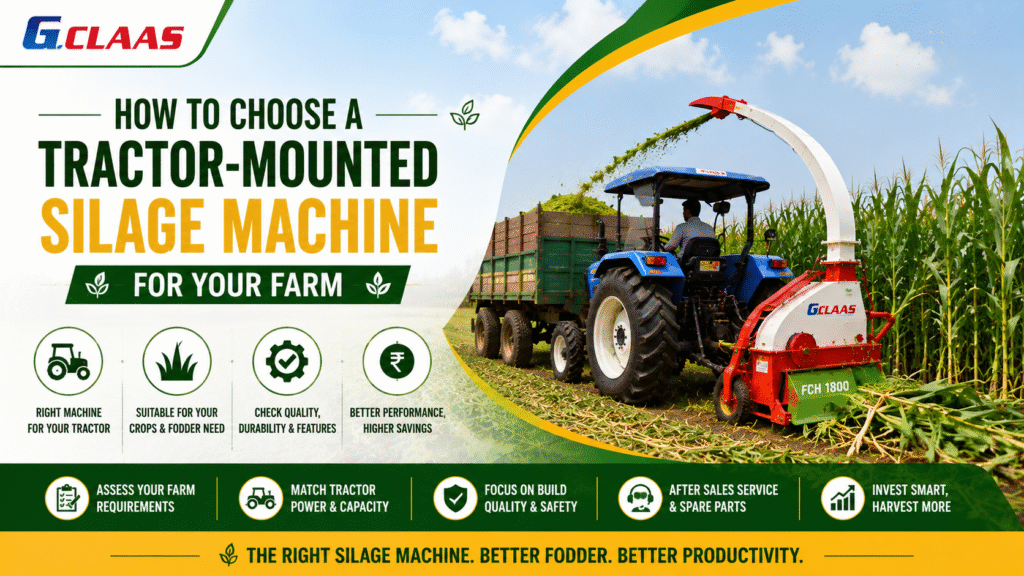
A suitable discharge chute can deliver chopped fodder to a trailer moving alongside or behind the harvesting operation. This minimises the manual collection and loading of the harvested material for workers.
Before you buy, check:
- Rotation of chute
- Distance thrown
- Trailer compatibility
- Discharge height
- Adjustment ease
Your transport system should be able to integrate well with the discharge system.
7. Field Conditions
The conditions of the fields in Indian farms can be quite different. The harvesting performance can be affected by the soil type, field size, crop density, field layout, and moisture.
A machine that is efficient in one area may require different operating parameters for another.
For example:
- Irregular or narrow fields
- Soil, wet
- Rough terrain
- Thick feed crops
- Various crop heights
- Boundaries of small fields
A practical field demonstration might be more useful than relying solely on brochure specifications.
8. Maintenance Requirements Comparison
Harvesting machinery works in difficult conditions. Crop residue, dust, moisture, and more hours of operation can also increase wear and tear on moving parts.
Select a machine that allows easy access to those parts that require regular inspection and maintenance.
Review:
- Lubrication points
- Blade change
- Belt & Chain Maintenance
- Bearings inspection
- Clean access to
- Requirements on lubrication
- Availability of spare parts
Simple maintenance can reduce downtime and keep the machine ready for the harvesting season.
9. After-Sales Service and Spare Parts Inspection
The after-sales support is particularly important for agricultural machinery, as the windows for harvesting can be short.
Technically, a machine can be capable, but the value can be reduced if downtime is long due to unavailability of parts.
Before you buy, ask:
- Where is the closest service centre?
- Are spare parts easily available?
- Does it include installation support?
- Is there training for the operator?
- What warranty is given?
- Average service technician response time?
On-field service and technical support for its forage harvesting equipment is available from G Claas.
Consider the Total Cost, Not Just the Purchase Price
The cheapest silage machine is not always the most economical.
Look at the total cost of ownership:
- Purchase price + tractor running costs + fuel + maintenance + spare parts + labour + downtime
A higher initial price of a machine may be offset by better value in terms of higher productivity, lower maintenance requirements and reliable service support.
The buying guide published by G Claas in 2026 also states that the purchase price should be considered in conjunction with tractor compatibility, operating costs, spare parts, service support and farm expansion in the future.
Tractor-Mounted vs Self-Propelled Silage Machine
| Factor | Tractor-Mounted Machine | Self-Propelled Machine |
| Power source | Tractor PTO | Dedicated engine |
| Initial investment | Generally lower | Generally higher |
| Existing tractor | Can utilise existing tractor | Not required |
| Farm size | Small- to medium-sized operations can be suitable. | Large-scale operations |
| Flexibility | Can use the tractor for other farm work | Dedicated harvesting machine |
| Capacity | Depends on the implement and tractor | Generally higher |
| Operating requirements | Requires compatible tractor | Requires dedicated machine operation |
The best option depends on your farm’s annual fodder requirement, available tractor, and harvesting schedule.
Is there a tractor-mounted silage chopper for your farm?
A tractor-mounted machine is a practical option.
- You already have a proper tractor.
- You grow maize, napier grass, sorghum, or other fodder crops that grow along with it.
- Your yearly harvesting area is medium.
- You want to cut down on manual harvesting.
- “You need a machine that will work with the farm equipment you already have.
- You want to get the harvesting done faster, but you don’t want to buy a self-propelled machine.
For very large farms or professional harvesting contractors with large acreages, a system with a higher capacity may be required.
Why you should think about G Claas Forage Harvesters
G Claas markets its forage harvesters as machines built for Indian farming conditions and for use with maize, Napier grass, bajra and other crops. The company emphasises Japanese technology, easy operation, durable construction and labour savings.
Farmers should always compare the specific model on power requirement, crop compatibility, capacity, chop length, price, warranty and service coverage before making a purchase.
Also Read: Best Forage Harvester for Maize, Napier Grass and Sorghum in India
Conclusions
Choosing the right tractor-mounted silage machine is more than just comparing prices. “The machine should match your tractor, your crops, your acreage, your harvesting schedule and your silage needs.
First, check the PTO compatibility and power delivery capability. Then assess crop compatibility, harvesting capacity, chop-length adjustment, cutting performance, discharge system, maintenance and spare-parts availability. Finally, consider after-sales service and total cost of ownership.
The right tractor-mounted forage harvester for maize, Napier grass, sorghum and other green fodder crops can reduce manual labour, speed up harvesting and improve fodder handling.
Ultimately, a well-matched machine works efficiently with your tractor, your crops, and your farm’s actual workload.
Frequently Asked Questions
1. What is a tractor-mounted silage machine?
Ans: A silage harvester is a forage harvesting implement attached to a tractor, normally driven by the PTO. It cuts and chops green fodder for silage or for feeding cattle.
2. What HP tractor is required for a silage machine?
Ans: Horsepower requirements differ for each machine model. Some tractor-powered forage machines require 35 to 50 HP or so, and heavier machines may require more. Always follow the manufacturer’s recommended PTO power rather than just engine horsepower.
3. Can a silage machine on a tractor harvest maize?
Ans: Yes. Suitable forage harvesters are capable of harvesting maize for silage. However, farmers should verify that the specific machine is designed for the maize crop and required harvesting configuration.
4. Is it possible to use the same machine for Napier grass and sorghum harvesting?
Ans: Certain multi-crop forage harvesters are capable of harvesting Napier grass, sorghum, and other fodder crops. Always check the manufacturer’s crop specifications before purchase.
5. What is the importance of chop length in silage?
Ans: Consistent chop length aids in producing more uniform material for packing and compaction. 8. If the rest of the silage-making process is managed well, this can be beneficial for improved fermentation and reduction of spoilage risk.